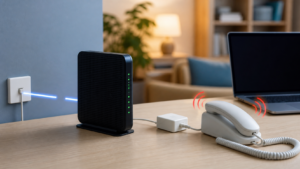
If your WiFi keeps disconnecting every few minutes, first check whether it happens on one device or every device. Then test beside the router and, if possible, compare WiFi with Ethernet. Those three checks usually point to the right part of the connection: the device, wireless coverage, the router, or the internet service.
Start with the short fixes below, but change one thing at a time. If you restart, reset, update, and rename everything together, you may restore the connection without learning what caused the drop.

Start with these four checks
| What you observe | Likely area | Best first step |
|---|---|---|
| Only one phone or computer disconnects | Saved network, adapter, driver, VPN, or device setting | Forget the WiFi network, reconnect, and update that device |
| Every WiFi device drops at the same time | Router, modem, interference, or internet service | Restart the network equipment and compare with Ethernet |
| The connection is stable beside the router but drops in one room | Weak signal, obstacles, or band choice | Improve router placement and compare 2.4 GHz with 5 GHz |
| WiFi and Ethernet both lose internet access | Modem, router’s internet connection, or provider | Check equipment lights and the provider’s outage page |
| The drop happens at an exact repeating interval | Router setting, scheduled task, or device software | Record the times and check router and device logs |
Do not judge from one speed test. A connection can be fast between dropouts and still be unreliable. Note what actually changes when the problem occurs: Does the WiFi icon disappear? Does it stay connected but show no internet? Does a video call freeze while ordinary web pages still load?
If the dropping connection is a Starlink Mini and the app shows Disconnected, use our Starlink Mini disconnected checklist. That message can mean the phone is not communicating directly with the Mini, so check the local WiFi and power before treating it as a satellite outage.
1. Find out whether one device or the whole home is affected
When the next disconnect happens, immediately check another phone, laptop, or television on the same WiFi. Turn off mobile data on the phone during this test so it cannot hide the outage.
- One device fails: Work on that device first. The router may be fine.
- All WiFi devices fail: Check the router, modem, signal environment, and internet service.
- Only one app fails: Check that app or service before changing the home network.
If the issue is limited to one phone or computer, use our one-device WiFi troubleshooting checklist. It covers saved networks, automatic IP and DNS settings, software conflicts, and hardware checks in more detail.
2. Restart the modem and router without resetting them
A normal restart clears a temporary fault without erasing your network name or password. If you have a separate modem or fiber gateway and router, switch both off. Wait about 30 seconds. Power the modem or gateway on first and let it reconnect, then power on the router. Combination units need only one restart.
Do not press the recessed Reset button. That performs a factory reset on many routers and can remove settings you need to get back online.
Google’s Android connection troubleshooting page also recommends restarting the phone and home router as early checks. If the drops return soon after a restart, keep going. A reboot that helps for only an hour is evidence, not a complete fix.
3. Fix a device that keeps leaving WiFi
Forget the saved network and join it again. Make sure you know the WiFi password before removing the network.
- Windows 11: Open Settings > Network & internet > Wi-Fi > Manage known networks, select your network, and choose Forget.
- iPhone or iPad: Open Settings > Wi-Fi, tap the information button beside the network, and tap Forget This Network.
- Android: Open Settings > Network & internet > Internet, open the saved network, and choose Forget. Menu names vary by phone maker.
Apple notes that forgetting a network on a device using iCloud Keychain can also remove it from other devices signed in to the same Apple Account. Review the details in Apple’s guide to forgetting a WiFi network before doing this on a managed work or school device.
Pause a VPN, private relay, security app, or custom proxy for one test. Do not leave protection disabled. The goal is to see whether the disconnect stops long enough to identify a software conflict.
Windows laptop disconnects after sleep or on battery
Install Windows updates, then get the wireless driver for your exact laptop model from the computer maker. Avoid generic driver download sites.
Next, open Control Panel > Hardware and Sound > Power Options. Choose Change plan settings, then Change advanced power settings. Under Wireless Adapter Settings, set Power Saving Mode to Maximum Performance for a test. Microsoft’s Windows WiFi troubleshooting guide recommends checking this setting when a wireless connection drops frequently.
If the problem began immediately after a driver update, check the adapter’s Driver tab in Device Manager for a rollback option. Do not repeatedly uninstall the adapter unless you already have the correct replacement driver available.
4. Test beside the router, then in the problem room
Use the same device for both tests. Stand in the same room as the router for several minutes and repeat the activity that usually fails. Then return to the room where disconnects happen.
If the nearby test is stable, the internet service and device may be fine. Walls, floors, metal appliances, mirrors, a television, or the router’s position can weaken the radio link. Put the router in the open and above floor level, not in a cabinet or behind a large screen. Our WiFi signal and router placement guide has a room-by-room checklist.
Do not assume that full signal bars rule out interference. Bars estimate strength, not how cleanly devices can use the channel.
5. Compare 2.4 GHz and 5 GHz
If your router shows separate network names for 2.4 GHz and 5 GHz, test each band. Near the router, 5 GHz often has more capacity and less range. Farther away or through several walls, 2.4 GHz may hold a connection better. The right band depends on your room and nearby networks.
Some routers use one network name and automatically steer devices. You can still use the near-router and distant-room comparison. Avoid changing many advanced radio settings at once.
For router settings, Apple recommends automatic channel selection, automatic channel width, current firmware, and modern WPA security settings. Check the full recommended router settings from Apple before copying a channel or security mode from an old forum post.
| Band test result | What it suggests | What to try |
|---|---|---|
| 5 GHz works near the router but drops farther away | Range or obstacles are limiting that band | Improve placement or use 2.4 GHz in the distant room |
| 2.4 GHz drops even near the router | The band may be busy or affected by interference | Leave channel selection on automatic, restart, and retest |
| Both bands fail on one device | The device adapter, driver, or software is more likely | Reconnect the network and update that device |
| Both bands fail on every device beside the router | The router or its internet connection needs attention | Check firmware, equipment lights, Ethernet, and provider status |
6. Check whether WiFi disconnects or the internet goes down
A device can remain connected to the router while the router loses its internet connection. The message may look similar, but the fix is different.
- When the problem occurs, look at the WiFi icon and the router or modem lights.
- Try opening the router’s local address. On Windows, run
ipconfigand use the listed Default Gateway. - If possible, connect the same computer to the router by Ethernet and repeat the test.
- Write down the time and which devices failed. A pattern helps your provider or router support team.
If WiFi loses the connection while Ethernet stays stable, focus on the wireless link. Our guide to testing WiFi against Ethernet shows how to compare the router and internet paths. If both connections fail together, check the modem or fiber gateway, provider outage page, and cables between the network devices.
7. Look for a repeating time pattern
A drop that happens at nearly the same time every hour or every evening gives you a useful clue. Record the start time, duration, affected devices, whether Ethernet also failed, and what the equipment lights showed.
Check the router for scheduled restarts, automatic maintenance, parental controls, and firmware updates. Also look for a device task that starts on a schedule, such as cloud backup or a large game update. Heavy traffic may make calls or games unusable without fully disconnecting WiFi.
Windows can create a wireless connection history. Open Command Prompt as administrator and run:
netsh wlan show wlanreportThe report covers recent WiFi sessions and includes disconnect reasons, adapter details, and errors. Check the time of each failure against your notes. Review the report before sharing it because it contains information about the computer and nearby networks.
8. Update the router before replacing it
Open the router’s official support page and find instructions for the exact model. Install current firmware or enable automatic updates if the router supports them. Save a backup of the configuration first when the manufacturer recommends it.
Feel the air around the router and make sure its vents are not blocked. Do not stack it on a hot modem, game console, or other device. If every WiFi device drops even beside the router, Ethernet remains stable, and firmware plus placement changes do not help, the router’s wireless hardware may be failing.
When to call the ISP or replace equipment
- Call the internet provider when WiFi and Ethernet fail together, the modem or fiber gateway loses its online light, or the provider reports a line fault.
- Contact the device maker when one laptop or phone disconnects from several different WiFi networks while other devices stay connected.
- Consider better coverage when the connection is stable beside the router but repeatedly drops in a distant room after placement improvements.
- Consider replacing the router when every wireless device drops close to it, Ethernet stays stable, and current firmware plus a clean restart do not help.
Bring your notes when you contact support. Exact times, affected devices, equipment lights, and the Ethernet comparison are much more useful than saying the internet is unreliable.
Common questions
Why does WiFi disconnect and reconnect by itself?
The device may be moving between bands or access points, losing a weak signal, saving power, or recovering after the router briefly stops responding. Test one device versus all devices and compare locations before changing settings.
Why does WiFi disconnect only on my laptop?
A saved network problem, wireless driver, power setting, VPN, or failing adapter is more likely when every other device stays connected in the same room. Forget and rejoin the network, update the laptop from its manufacturer, and test another WiFi network.
Will changing DNS stop WiFi from disconnecting?
Usually not. DNS translates website names into addresses. It does not keep the radio link between a device and router connected. Change DNS only when the device stays on WiFi and testing points to a name-resolution problem.
Should I use 2.4 GHz or 5 GHz for a stable connection?
Use the band that remains stable where the device is used. Test 5 GHz near the router and 2.4 GHz in distant rooms. Nearby interference and your home’s walls matter more than a universal rule.
Sources
- Microsoft Support: Fix WiFi connection issues in Windows
- Apple Support: Recommended settings for WiFi routers and access points
- Apple Support: Forget a WiFi network or prevent automatic joining
- Android Help: Fix internet connection problems
This article is a research-based troubleshooting guide. The steps should help you isolate the failing part of the connection, but they do not replace diagnosis by your internet provider, router maker, or device manufacturer.