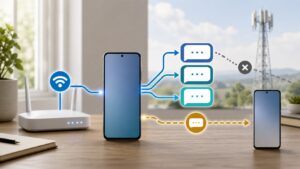
Your iPhone can show a WiFi icon even when the router is not giving it a working internet path. Start by checking another device on the same network. Then test the iPhone on a different WiFi network before changing settings or resetting saved networks.
Use the symptom to choose the first test
| What happens | First test | Likely area |
|---|---|---|
| Only the iPhone is offline | Try another device on the same WiFi | iPhone setting, VPN, or local lease |
| Every home device is offline | Check the modem or router internet light | Router, modem, or ISP |
| The iPhone works on another WiFi | Compare the home network settings | Home router, DNS, or DHCP |
| Only one app fails | Open a different site or app | App or service, not WiFi |
1. Check whether the problem is only the iPhone
Connect a laptop or another phone to the same WiFi and open a few different sites. If those devices also fail, do not erase the iPhone’s network settings yet. Check the router’s WAN or internet light, then restart the modem and router using their normal power controls. If the outage continues on wired devices, contact the ISP.
If other devices work, continue on the iPhone. Apple also recommends trying the same WiFi on other devices when an iPhone reports no internet, because that separates a phone problem from a network problem.
2. Test Safari and another app
Open a new page in Safari, then try an app that normally uses the internet. If Safari works but one app does not, force-close and reopen that app, check for an update, and look for a service outage. A single app failure is not a reason to change router DNS.
If no app or site loads, turn WiFi off and back on from Control Center or Settings. Wait a few seconds between the two actions. Check whether the WiFi network shows a warning such as “No Internet Connection.”
3. Forget and rejoin the WiFi network
Use Settings > WiFi, tap the information button beside your network, choose Forget This Network, and join again with the correct password. This removes the saved profile for that network, so make sure you know the password before proceeding.
After rejoining, stay near the router for the first test. If the iPhone works close to the router but not in its usual room, the saved profile was not the main problem. Check placement, walls, and the 2.4 GHz versus 5 GHz choice instead.
4. Check VPN, security, and private relay settings
A VPN or filtering profile can block traffic after the WiFi connection itself succeeds. Temporarily pause a VPN from its own app, then test Safari again. If a work or school profile is installed, do not remove it without following that organization’s instructions.
Private Relay and IP-address tracking options can interact with some networks. Test one setting at a time and record the original value so you can restore it. Do not disable security features permanently just to make one public WiFi network work.
5. Check the network details without guessing
Tap the information button beside the WiFi name and confirm that the iPhone has an IP address, router, and DNS entries. Do not copy a random IP address from a forum. An address beginning with 169.254 usually means the phone did not receive a usable address from the router, so restart the router and test another device before entering manual values.
If only this iPhone cannot obtain an address while other devices work, the router may have a device limit, access-control rule, or stale lease. Check the router’s client list and blocked-device list before changing DHCP ranges.
6. Try a different WiFi network
Connect the iPhone to a trusted second network, such as a personal hotspot or another home network. If it works there, the iPhone’s WiFi hardware is less likely to be the cause. Focus on the home router, captive portal, DNS response, or ISP path.
If the phone fails on every WiFi network but cellular data works, install any available iOS update and restart the phone. Persistent failure across several networks is a reason to contact Apple Support rather than repeatedly resetting the router.
7. Reset network settings only as a last phone-side step
Network reset removes saved WiFi networks and passwords, plus VPN and other network settings. Use Settings > General > Transfer or Reset iPhone > Reset > Reset Network Settings only after the earlier comparisons point to the phone. Save important WiFi passwords first and expect to rejoin networks afterward.
When the router or ISP is the real problem
If the iPhone and a wired computer lose internet together, the phone is only reporting the outage. If the iPhone works on a different WiFi but every device fails at home, collect the time, router status, and wired result for the ISP. If only the iPhone fails at home and forgetting the network does not help, check VPN or access-control settings before buying a new router.
For a broader branch-by-branch checklist, use our guide to WiFi connected but no internet. If only one device is affected, also see the one-device WiFi troubleshooting guide.
Quick checklist
- Test another device on the same WiFi.
- Try Safari and a second app.
- Toggle WiFi and rejoin the network.
- Pause a VPN or filtering app for one test.
- Check the iPhone’s IP, router, and DNS fields.
- Try a trusted second WiFi network.
- Reset network settings only after saving passwords.