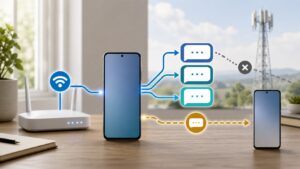
Wi-Fi calling can be useful when your home has a weak cellular signal, but a good Wi-Fi connection does not guarantee that the feature will activate. The carrier must support Wi-Fi calling, the line must be provisioned for it, and the phone still has to complete its setup. Start with the phone and account before changing router settings.
First, identify what is failing
| What you see | Start here | Most likely area |
|---|---|---|
| Wi-Fi calling is missing from Settings | Check carrier support and the active SIM | Carrier plan, region, or phone model |
| The switch is present but will not turn on | Confirm the emergency address and restart the phone | Carrier activation or account setup |
| It turns on, but calls still use cellular | Test with weak cellular signal and verify the Wi-Fi indicator | Phone preference or carrier handoff |
| Calls drop only on home Wi-Fi | Try another Wi-Fi network | Router, filtering, or network compatibility |
1. Check that your carrier and line support Wi-Fi calling
Wi-Fi calling is a carrier feature, not a switch that every phone can use on every plan. Google says that not all carriers support it. If the option is missing, contact the carrier before resetting your router or phone. Ask whether Wi-Fi calling is available for your exact line, device, and location.
A recently replaced SIM, eSIM, number transfer, or plan change can also require the carrier to activate the feature again. If the carrier says the feature is supported but the phone still cannot register, ask support to check Wi-Fi calling provisioning on the line.
2. Turn on Wi-Fi calling and complete the address step
On an iPhone, open Settings, tap Cellular, select the line if you use more than one SIM, then tap Wi-Fi Calling. Turn on Wi-Fi Calling on This iPhone. Apple may ask you to enter or confirm an address for emergency services. The feature may not finish activating until that information is accepted.
On Android, the menu varies by phone maker. On phones using the Google Phone app, open Settings, choose Network & internet, SIMs, the carrier SIM, and Wi-Fi calling. If that option is not available, the carrier may not support it on that device or line.
3. Restart the phone, then wait for registration
After enabling the feature, restart the phone and give it a short time to register. Turn Wi-Fi off and on once, then look for a Wi-Fi indicator beside the carrier name or in the call screen. Do not use a speed test as the only check. A fast download can still coexist with a carrier registration problem.
4. Test a different Wi-Fi network
Connect the phone to another trusted Wi-Fi network, such as a friend’s network. Apple notes that not every Wi-Fi network works with Wi-Fi Calling. If calls work elsewhere, the phone and line are probably ready, so focus on the home network. If Wi-Fi calling fails everywhere, contact the carrier or phone maker instead of changing router settings at random.
5. Pause VPNs, private DNS, and filtering apps
Temporarily pause a VPN, custom DNS service, security filter, or parental-control app on the phone. These tools can change how traffic leaves the network. Test one call, then turn the protection back on. If Wi-Fi calling works only while a service is paused, update the app or ask its provider how to allow carrier calling traffic.
6. Check the router only after the phone passes the other tests
Restart the router normally, without using a factory reset. If the router has parental controls, access rules, guest-network isolation, or aggressive traffic filtering, test the phone on the main network with those rules paused one at a time. Do not disable the firewall permanently.
Some routers separate 2.4 GHz and 5 GHz networks. Join the other band for a test, but do not assume that a band change will repair carrier activation. If the phone can browse and make Wi-Fi calls on another network, the home router or its filtering rules deserve closer attention.
7. Reset network settings only as a last phone-side step
Network reset removes saved Wi-Fi networks and passwords. Apple lists it after restarting and trying another Wi-Fi network. Use it only when you have the Wi-Fi password and understand which VPN, cellular, and network settings will be removed. Reconnect to Wi-Fi, enable Wi-Fi calling again, and repeat the emergency-address step if the phone asks.
When to contact the carrier
Contact the carrier when the Wi-Fi Calling switch is missing, activation fails after the address step, or calls fail on more than one trusted Wi-Fi network. Give support the phone model, active SIM, software version, exact error message, and the result of the different-network test. That information helps separate an account problem from a home Wi-Fi problem.
Quick checklist
- Confirm carrier and line support.
- Turn on Wi-Fi calling and complete the emergency-address step.
- Restart the phone and wait for registration.
- Test another trusted Wi-Fi network.
- Pause VPN, custom DNS, and filtering apps for one test.
- Restart the router and review device-specific rules.
- Reset network settings only after saving the Wi-Fi password.
Sources
Apple: Make a call with Wi-Fi Calling
Google Phone app Help: Make calls over Wi-Fi
For a separate device connection problem, see our guide to Wi-Fi failing on one device and our iPhone connected to Wi-Fi but without internet guide.